
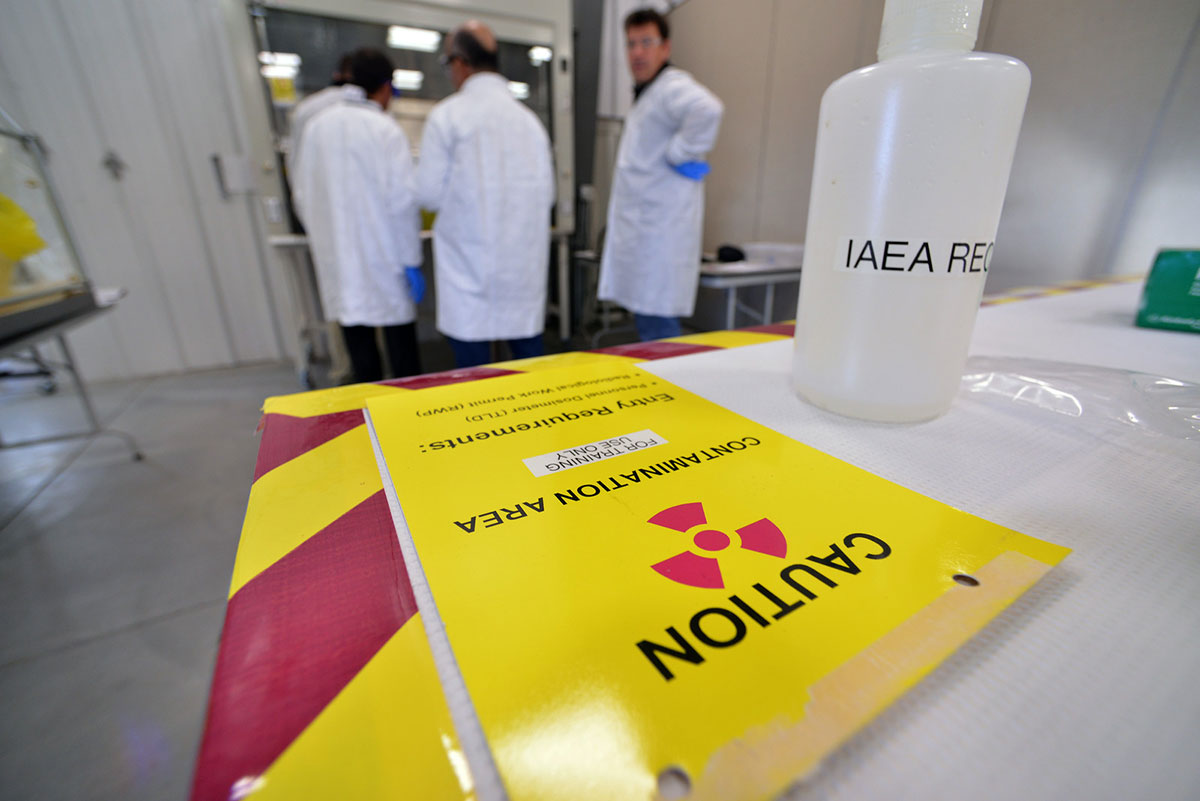
When customs agents or border security intercept a suspicious shipment containing radioactive material, the real work begins in a laboratory, where scientists must determine what the material is, where it came from, and whether it was meant for legitimate use or something far more dangerous. A newly published research details how one European institute has built and tested its capabilities for exactly that task.
The paper, published in Applied Radiation and Isotopes, comes from researchers at the Laboratory of Nuclear Analytical Techniques at the Institute of Nuclear Chemistry and Technology (INCT) in Warsaw, Poland. The authors summarize the institute’s recent work in nuclear forensics, the scientific discipline of analyzing seized nuclear and radioactive materials to reconstruct their origin, history, and intended purpose.
Nuclear forensics emerged as a distinct field in the early 1990s, following the collapse of the Soviet Union and the wave of nuclear material smuggling cases that followed across Central and Eastern Europe. The International Technical Working Group (ITWG) formed in 1996 to coordinate the field internationally, and the International Atomic Energy Agency (IAEA) has since logged more than 4,000 voluntarily reported cases of illicit trafficking in nuclear and radioactive material between 1993 and 2023. INCT has represented Poland in the ITWG since 2019 and participates in IAEA-coordinated research alongside its own laboratory investigations.
The paper describes three analytical techniques the INCT team applies to intercepted materials: gamma-ray spectrometry, which identifies radioactive isotopes by the specific energy of radiation they emit; inductively coupled plasma mass spectrometry (ICP-MS), which determines a sample’s precise elemental and isotopic makeup; and liquid scintillation counting (LSC), which detects certain types of radioactive decay with high sensitivity. Applied together, these methods let investigators build what the field calls a material’s “fingerprint,” a profile covering its physical properties, radioactivity, chemical composition, and clues to its age, production history, and intended use.
Much of the described work took place through the ITWG’s Collaborative Materials Exercises (CMX), international proficiency tests in which laboratories receive unknown radioactive samples and are evaluated on how well they characterize them within set reporting windows of 24 hours, one week, and two months. INCT took part in three such exercises, analyzing materials that included depleted uranium and cerium metal ingots laced with trace amounts of weapons-grade plutonium, a depleted uranium-vanadium alloy, uranium scrap metal, and uranium in both nitrate and oxide powder forms. Separately, through an IAEA-coordinated research project, the team used ICP-MS to analyze uranium ores of varying composition, including pitchblende, and examined rare earth element patterns within them as a potential signature for tracing ore back to its geological and geographic source.
The authors note that nuclear forensics increasingly requires purpose-built separation procedures rather than off-the-shelf analytical chemistry methods, particularly for isotopes tied to the nuclear fuel cycle and medical applications, given the complexity of the materials investigators may encounter. Citing IAEA trafficking data, they point out that nuclear material itself accounts for a relatively small share of reported cases, 14 percent between 1993 and 2024, while the bulk involve other radioactive materials that could still be used in a radiological dispersal device, or “dirty bomb.”
Nuclear forensics sits at the intersection of nuclear security and criminal investigation, and a laboratory’s ability to rapidly and accurately characterize an intercepted sample can shape everything from attribution of responsibility to law enforcement response and diplomatic action. By detailing its participation in CMX exercises and IAEA research, INCT’s work illustrates how national laboratories contribute to the broader international framework meant to detect and deter nuclear trafficking, and offers a model other nations building or expanding their own forensic programs may draw from.
The paper is a methods and capabilities summary rather than a controlled experimental study, so it does not report a specific error rate or diagnostic performance figure for the described techniques, though the authors describe results as demonstrating that combined radiological, elemental, and isotopic analysis enables comprehensive characterization of seized nuclear materials.
Sources and further reading:
Topyła E, Kalbarczyk P, Chajduk E. Development and application of nuclear forensic analytical capabilities at the Institute of Nuclear Chemistry and Technology. Applied Radiation and Isotopes, 20 August 2026.
This article was researched and sourced by CBRNE Central editors and reported with Claude AI assistance for drafting and editing.