

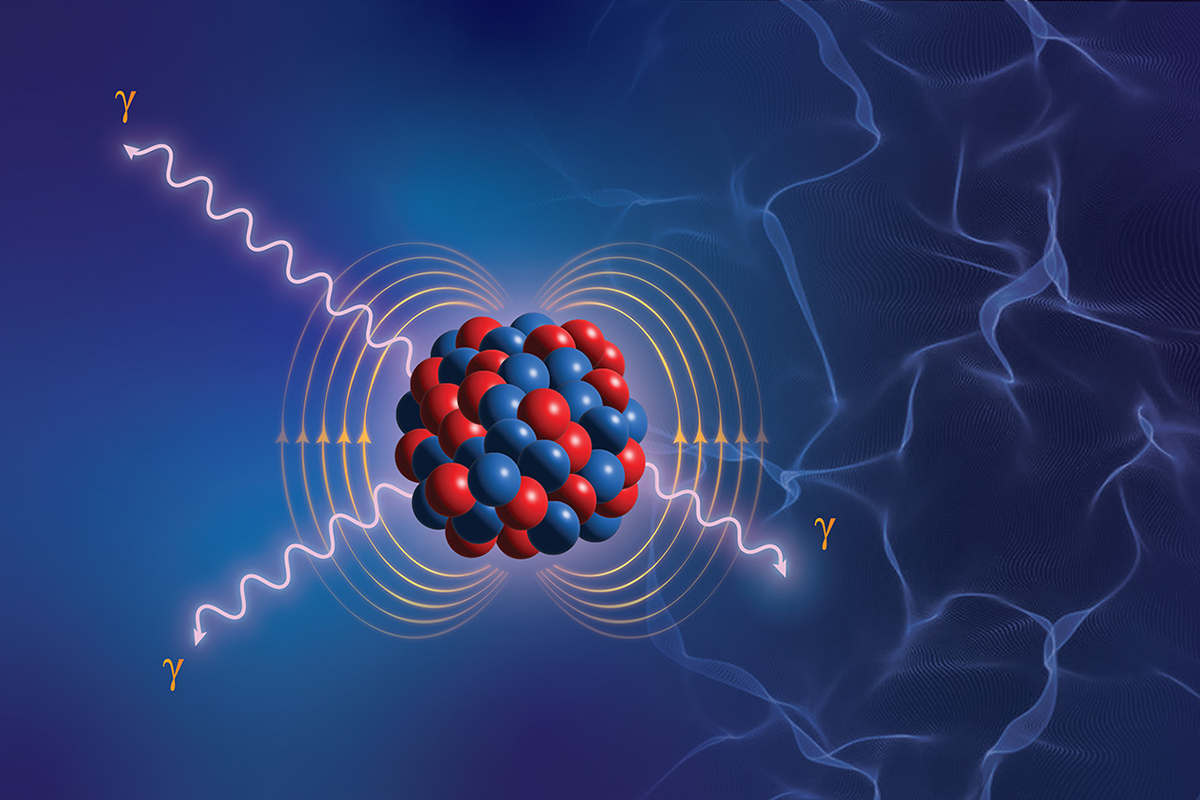
For more than two decades, physicists have puzzled over a strange pattern in how certain atomic nuclei release energy. Some nuclei emit far more low-energy gamma rays than theory says they should, and nobody could explain why, or even reliably predict which nuclei would do it. A new study has finally solved that mystery, with implications reaching from the accuracy of national nuclear stockpile assessments to how heavy elements like gold and platinum are forged in the universe.
The research, published in the journal Nature, was led by Eleanor Ronning and colleagues at the Facility for Rare Isotope Beams (FRIB) at Michigan State University, with contributing scientists from Lawrence Livermore National Laboratory (LLNL). To understand the finding, it helps to know what gamma rays are: a form of electromagnetic radiation, in the same family as visible light and radio waves, that atomic nuclei give off as they settle down from a highly energized, unstable state into a calmer, more stable one. Think of it like a struck bell settling into silence, except the “sound” here is radiation, and the pattern of that radiation carries clues about the internal structure of the nucleus itself.
Scientists have long known that some nuclei ring out an unusual excess of low-energy gamma rays as they settle down, a quirk known as “low-energy enhancement.” What they didn’t know was why it happens, or which physical process inside the nucleus was responsible. There are two broad ways a nucleus can rearrange itself as it releases energy: an “electric” pathway, where the positively charged protons inside physically shift position, or a “magnetic” pathway, where the protons and neutrons essentially flip their internal magnetic orientation, like a compass needle reversing direction, without actually moving position. For 20 years, researchers couldn’t determine which of these two processes was driving the mysterious excess of low-energy gamma rays.
To find out, the team used the specialized instruments at FRIB to track a radioactive form of copper as it decayed into zinc, a process that gave off gamma rays along the way. Critically, the researchers found a way to isolate two different decay pathways within the same experiment, one that proceeded through the electric route and one that proceeded through the magnetic route, and then compared the gamma-ray output of each. Only the magnetic pathway produced the telltale excess of low-energy gamma rays. That gave the team direct, controlled evidence that the decades-old mystery had a magnetic explanation all along.
“This is a key step forward,” said Andrea Richard, the study’s co-lead author, a former LLNL postdoctoral researcher now at Ohio University. “We now have a consistent explanation that connects experimental observations with theory.”
Gamma-ray patterns like these are a foundational input for predicting how nuclei behave, and that predictive power feeds directly into how scientists assess the reliability of the nuclear weapons stockpile and interpret data from past nuclear tests, without requiring new testing. It also sharpens the tools used in nuclear forensics, the science of determining whether a nuclear event has occurred and tracing it back to its likely source. “We can improve the knowledge of our stockpile performance and interpretation of past test program results using the improved theory based on these discoveries,” said LLNL scientist and study co-author Darren Bleuel.
The findings will also help astrophysicists model how heavy elements form deep inside stars, in supernova explosions, and in the violent collisions of neutron stars, since the same gamma-ray physics governs the nuclear reactions responsible for building the periodic table’s heaviest elements.
The study examined this magnetic effect in a single type of atomic nucleus, zinc-70, so researchers still need to determine how consistently the same magnetic explanation applies across the many other nuclei known to show the low-energy enhancement effect, and why some nuclei display it while others do not. The authors describe this as the next open question the field can now pursue, building on a firmly established starting point rather than an unresolved one.
Sources and further reading:
Magnetic Clues in Atomic Nuclei Reveal the Truth About Mysterious Gamma Rays. Lawrence Livermore National Laboratory, 17 August 2026.
Ronning EK, Richard AL, Liddick SN, et al. Magnetic Character of the Low-Energy Enhancement in 70Zn. Nature, 15 July 2026.
This article was researched and sourced by CBRNE Central editors and reported with Claude AI assistance for drafting and editing.